
Best Cleaning Spray Used By Commercial Cleaning Company
When you are going for a commercial cleaning, choosing the right cleaning spray is important. The wrong cleaning spray will affect the entire premises.
No matter the expertise they bring to the table, the effectiveness of the overall cleaning procedure comes down to the choice of supplies that they go with. By Choosing the right cleaning supply suggested by commercial cleaning company will add value to your commercial building and improve the productivity.
Things To Consider Before Picking Your Cleaning Supplies
1. Approved By Standard Bodies
As stated earlier, knock-off products are practically everywhere around you. All you can do is simply ensure their effectiveness by cross-examining them with standard regulations around. Companies like JBN Cleaning always follow the guidance published by Safe Work Australia and NSW Health. This is to ensure that the cleaners remain resourceful and also perform procedures that are in adherence to international compliances.
Eco-friendly supplies usually come with standard approvals from bodies like the EPA (Environmental Protection Agency) or carry a DfE label (Design For the Environment). Encourage your cleaners to check these before grabbing any supplies off the shelf.
2. Chemically Neutral
Elements like Ammonia, sulphur, bleach, and acid compositions should be strictly avoided at all costs. They leave behind a pungent smell even after cleaning and reduce the air quality of the surroundings. In addition to this, they also result in causing side effects to the people around them.
Allergies, eye irritations, rashes, asthmatic triggers, etc are all some of the expected effects of cleaning with chemically-intensive supplies. Any cleaning spray that you choose for your disinfection procedures should steer clear from these strictly at all costs.
3. Residue-Free
There are product compositions that leave behind residues after cleaning. Any effective cleaning product should be free from resulting in these. Cleaning supplies should be gentle on the surfaces and effectively clean up after them without requiring any other supply to effect the same. They should be self-sufficient in handling the requirement at their disposal.
While going about your office cleaning, you should take into account all of these above factors and only pick products that are effective in all respects.
Cleaning Sprays Generally Used While Cleaning
Any commercial cleaning company in Sydney will be extra careful with respect to the products they pick or the sprays that they employ. Here’s a quick gist of some of the common supplies.
Regular Disinfectants
They’re widely available and used across most commercial sites for routine hygiene and high-touch surfaces. Always go with products that limit the disposition of harmful volatile organic compounds while still being effective with respect to the termination of germs.
Aerosol Disinfectants
Aerosol and spray-applied disinfectants are useful for awkward, hard-to-reach spots where a cloth won’t easily go. What they are not is a substitute for cleaning. Routine fogging or misting of whole rooms is no longer recommended as a primary disinfection method: it skips the friction that physically removes soil, coverage can’t be verified, and airborne disinfectant is a respiratory risk to the operator and to anyone re-entering too early. Applying a product by fogging when its label doesn’t include fogging directions is also off-label use. Keep aerosols for spot application, and clean the surface first.
Neutral pH Cleaners
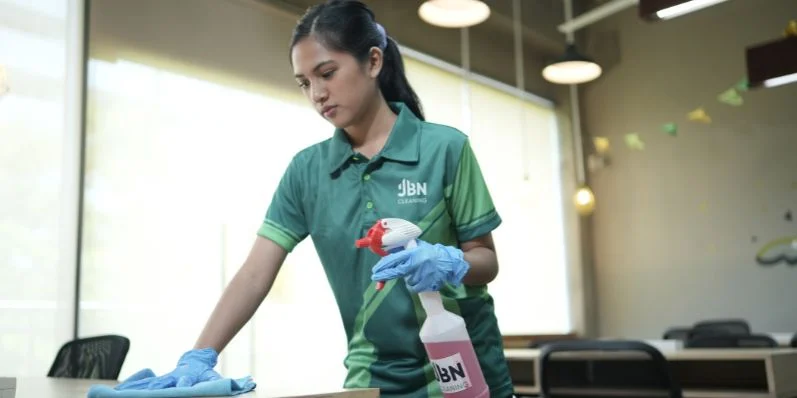
They are used for wiping hard surfaces, including furniture, office desks, table top, and even walls. They’re also employed in careful proportions for the cleaning of ceramic floors, bathroom tiles, and vinyl floors.
Degreasers
They’re widely looked up to for their effectiveness in treating tough stains that have accumulated over a period of time. They’re especially handy for treating easily stained spaces like warehouse cleaning, industrial cleaning, or factory cleaning. Degreasers are usually employed with scrubbing processes for added effectiveness.
Oil spill dispersants, scale removers, glass cleaners, neutralized phosphate dispersants, concentrate detergents, hydrocarbon-based solvent cleaners, and solvent degreasers are some of the other products that are employed with cleaning sprays for various niche requirements.
All these diverse supplies each with their own method of application and direction of use are the reason why you need experienced cleaners in the picture. Unlike the common myth, commercial cleaning packages are not actually costly as it seems. They’re a more economic option compared to the capital investments you need to be dealing with if you decide to stock them up for an in-house team.
Frequently Asked Questions
What cleaning sprays does a commercial cleaner use?
The common set is regular disinfectants for routine hygiene and high-touch surfaces, neutral pH cleaners for desks, walls and hard floors, degreasers for built-up grease and stains, and aerosol disinfectants for hard-to-reach spots. Specialist jobs add glass cleaners, scale removers and solvent degreasers.
What certifications should commercial cleaning products carry?
Look for genuine third-party approval rather than marketing claims an EPA registration or a Design for the Environment (DfE) label. In Australia, procedures should also follow Safe Work Australia and NSW Health guidance.
Which chemicals should be avoided in office cleaning?
Ammonia, sulphur, bleach and acid-based compositions. They leave a pungent smell, reduce indoor air quality, and can trigger allergies, eye irritation, rashes and asthma in people using the space afterwards.
Is fogging or misting an effective way to disinfect an office?
No it is not recommended as a primary disinfection method. Fogging skips the friction that physically removes soil, coverage cannot be verified, and airborne disinfectant is a respiratory risk. Using a product this way when its label has no fogging directions is also off-label use.
Do you need to clean a surface before disinfecting it?
Yes. Organic soil deactivates disinfectants, including bleach, so disinfecting a dirty surface does not work. Clean first to remove the soil, then apply the disinfectant.
Is it cheaper to buy cleaning supplies in-house or hire a commercial cleaner?
Hiring is usually the more economical option. An in-house team means capital outlay on the full range of products plus the training to apply each correctly a contractor absorbs both and carries the right product for each surface.
Tell us your site size, floor types and cleaning frequency, and we’ll put together a quote for your premises. Call 1300 908 678 or send us your details
