
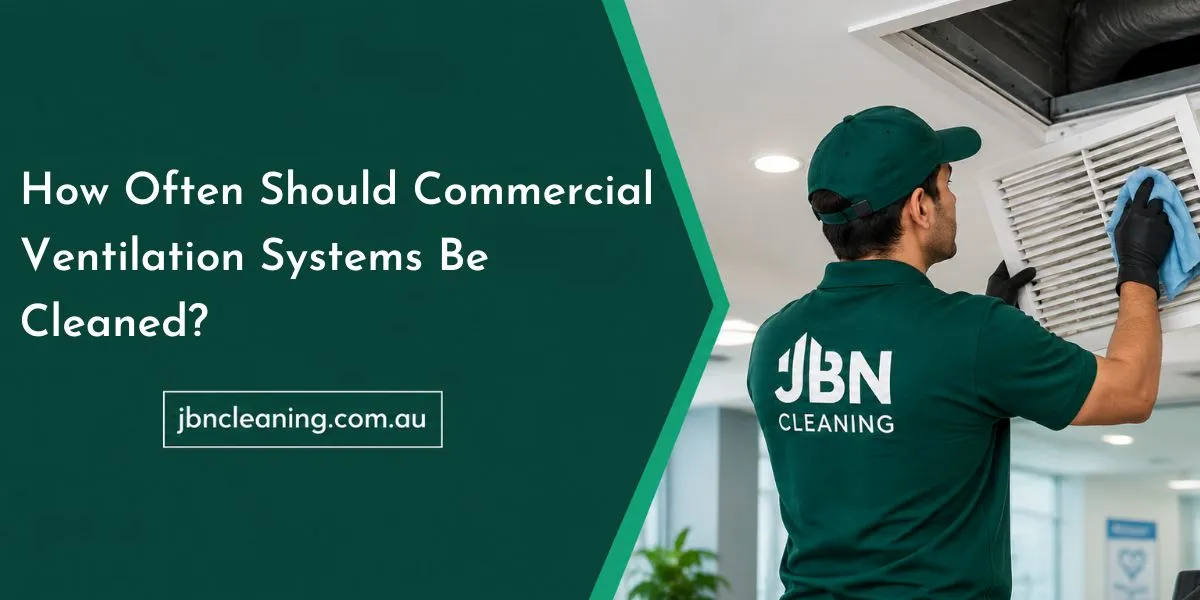
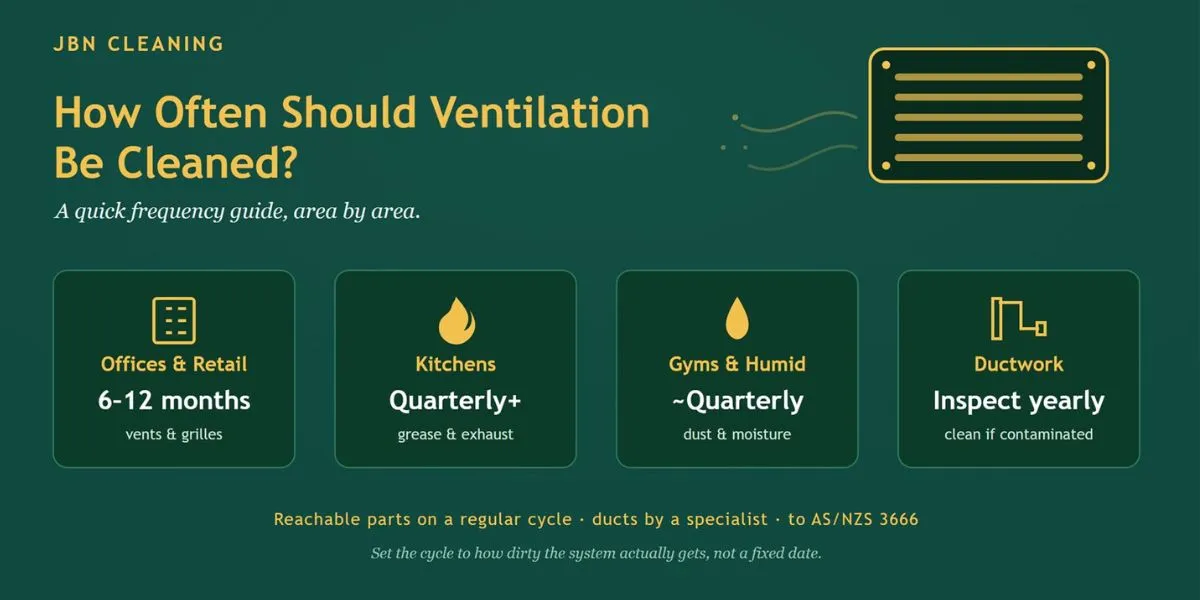
As a general rule, a commercial ventilation system should be inspected every year and cleaned whenever it gets dirty, but the right frequency depends on the area it serves. Offices and retail usually suit a six to twelve monthly clean, while kitchens, gyms and production areas need it quarterly or more. There is also an important split: the vents, grilles and fans you can reach are cleaned on a regular cycle, while the inside of the ductwork is inspected yearly and cleaned by a specialist only when it is actually contaminated. This guide gives the frequency by area, what the Australian standards expect, and the warning signs that say clean it now.
How Often Should Each Area Be Cleaned?
Different parts of a building collect grime at different rates, so a good ventilation cleaning schedule sets a cycle per area rather than one date for the whole site.
| Area or system | Suggested cleaning frequency |
|---|---|
| Office and retail vents and grilles | Every six to twelve months |
| Kitchens and food production | Quarterly or more, with exhaust under AS 1851 |
| Gyms, humid or dusty areas | Around quarterly |
| Ductwork interior | Inspect yearly, clean by a specialist when contaminated |
A fresh or lightly used office can stretch toward the longer end, while a busy, dusty or humid site needs the shorter cycle. The honest answer is set by how dirty the system actually gets, not a fixed date on the calendar.
What Do the Australian Standards Say?
Ventilation hygiene in Australia is guided by AS/NZS 3666, which covers microbial control in air-handling systems and calls for regular inspection and cleaning to keep the air supply clean. For commercial kitchens, the exhaust and canopy also fall under AS 1851, the standard for servicing fire-protection equipment, which is why greasy kitchen systems are cleaned far more often. The common thread is simple: inspect the system regularly, clean it before the build-up becomes a health, hygiene or fire problem, and keep a record that it was done. Responsibility usually sits with the building owner or the occupier under their lease and work health and safety duties, so it pays to know which one you are before a problem lands.
Which Parts Need a Specialist?
It helps to know which job you are buying, because the two look alike on a quote but cost very differently. Regular ventilation cleaning covers the parts people can reach and see: ceiling vents, diffusers, return-air grilles, exhaust fans, extraction points and kitchen canopies and filters, plus the surfaces around them. Full duct cleaning means working inside the ductwork itself, which is a separate specialist job with its own equipment. A good cleaning company in Sydney handles the reachable work on your regular cycle and tells you honestly when the internal ducts genuinely need a specialist, rather than selling a full duct clean when a surface clean is all that is due, and flagging the ducts early rather than after a costly failure.
What Signs Mean the System Needs Cleaning Now?
There are usually clear warning signs before a system becomes a problem. Weak airflow from the vents, visible dust around grilles, a stale or stuffy smell that lingers, more dust settling on desks than usual, or a quietly rising energy bill all point to a system that is overdue. In a kitchen, visible grease on the canopy or filters is the clearest signal of all. Acting early is far cheaper than waiting for a breakdown, a failed inspection or, in a greasy kitchen, a fire. Clean ventilation also protects the people in the building, dirty air worsens allergies and spreads illness, and a clogged system works harder and costs more to run, so staying on a sensible cycle pays for itself in sick days, energy and equipment life. Agreeing a schedule per area up front also turns it into a small, predictable cost, which is far easier to budget than an emergency call-out when the airflow fails on a hot day or an inspector asks for records you do not have.
Frequently Asked Questions
How often should ventilation be cleaned in an office?
Office vents, grilles and diffusers are usually cleaned every six to twelve months, sooner on a dusty or busy site, with the ductwork inspected yearly and cleaned by a specialist only when it is contaminated.
How often should ventilation ductwork be cleaned?
The ductwork interior is inspected annually and cleaned when contamination builds past an acceptable level, rather than on a fixed date. It is a specialist job, separate from the regular surface clean.
How often should air ducts be cleaned in a commercial kitchen?
Kitchen exhaust and ducts need much more frequent attention because of grease, typically quarterly or more, and fall under AS 1851 as part of fire-safety servicing.
What standard covers ventilation cleaning in Australia?
AS/NZS 3666 covers microbial control in air-handling systems, and AS 1851 covers kitchen exhaust as fire-protection equipment. Both call for regular inspection, cleaning and records.
Can one provider handle the whole system?
A cleaning company can cover all the reachable cleaning on one schedule, while the internal ductwork is a separate specialist job, so the whole system is managed without you juggling several contractors.
Book Commercial Ventilation Cleaning in Sydney
Clean ventilation protects your air quality and your energy bills and supports your compliance obligations, and it starts with a provider who cleans the reachable parts properly and is honest about when a specialist is needed. JBN Cleaning provides commercial ventilation cleaning across Sydney, covering vents, grilles, fans, and the outside of kitchen canopies and filters on a cycle set per area, with documented records for every visit. As a commercial cleaning company that also looks after your floors, amenities and office cleaning, JBN Cleaning keeps it all on one agreement and one standard. Call 1300 908 678 or 02 9188 5449, or email info@jbncleaning.com.au for a free, no-obligation quote.
