How Often Should Shopfront Windows Be Cleaned?
Most shopfronts need the entry door and lower glass cleaned weekly, and the full frontage inside and out…
Explore How Often Should Shopfront Windows Be Cleaned?
Commercial window cleaning is the scheduled cleaning of glass in a workplace or public building — shopfronts and entry glazing, internal partition glass and meeting room walls, atrium and stairwell glazing, strata lobby glass, and external glass at whatever height the building presents.
The whole job divides at one line: what can be reached safely from the ground or from inside, and what cannot. Everything below that line is routine work priced by area and frequency. Everything above it is work at height, which needs an access method, a plan, and equipment appropriate to the building — and it is priced accordingly, because the access is the job.
The governing law is the Work Health and Safety Act 2011 (NSW) and the Work Health and Safety Regulation 2017, regulated by SafeWork NSW. Falls from height are among the most serious risks the regulation deals with, and Safe Work Australia publishes a model code of practice on managing the risk of falls at workplaces that sets out the approach: eliminate the need to work at height where possible, and where it is not, use the highest level of control that is reasonably practicable.
JBN Cleaning provides internal and reachable external window cleaning across the Sydney metropolitan area from our base in Pendle Hill, as a standalone booking or as a scheduled item inside a cleaning contract.

Commercial window cleaning covers shopfront and entry glass inside and out, internal partitions and meeting room walls, reachable atrium, stairwell and lobby glazing, ground-floor external glass, and the frames, tracks and sills that are often skipped. Rope access and high-rise external glazing are specialist work, and we do not provide them.
Shopfronts and entry glazing. Inside and out, to a clean edge, including the frame face, the threshold and the door furniture. On a street-front business this is the highest-value glass in the building and it needs a frequency that matches the street rather than a generic cycle.
Internal partition and meeting room glass. Full-height office partitions, meeting room walls and internal doors. These mark up fast — hands, whiteboard markers, the back of a chair — and they are what a visitor walks past.
Atrium, stairwell and lobby glazing. Reachable internal glass in strata lobbies and building entries, with high internal glazing quoted against an access plan.
Ground-floor and low-level external glass. Reachable from the ground or from a safe platform, including the frames and sills.
Frames, tracks and sills. The detail that separates a proper job from a wipe of the pane. Sydney glass accumulates grit in the tracks, and a clean pane above a filthy track looks worse than neither.
Mirrors and internal glass fixtures where they are in the scope.
What we do not do. Rope access and high-rise external facade glazing. That is a specialist discipline with its own training, equipment and regulatory requirements, and a general commercial cleaner should not be quoting it. Where your building needs it, we will say so and stay within what we can do safely.
Glass is cleaned on a cycle matched to how exposed it is, and every quote names how the glass will be reached.
| Area | Task | How often |
|---|---|---|
| Shopfronts and entry glazing | Glass inside and out to a clean edge, frame face, threshold and door furniture | Weekly at minimum for street-front retail and hospitality |
| Office entry and lobby glass | Entry glass inside and out | Weekly to fortnightly |
| Office external glazing | Wider glazing | Quarterly to half-yearly |
| Internal partitions | Full-height partitions, meeting room walls and internal glass doors | Monthly to quarterly |
| Strata lobbies | Entry glass | Weekly, with the routine clean |
| Strata lobbies | Wider lobby and atrium glazing | Quarterly or half-yearly |
| Atrium and stairwell glazing | Reachable internal glass, high glass against an access plan | As scoped |
| Ground-floor external glass | Glass, frames and sills reachable from the ground or a safe platform | Quarterly to half-yearly |
| Frames, tracks and sills | Grit cleared from tracks, frames and sills wiped | Stated in the quote as in or out |
| Mirrors and glass fixtures | Mirrors and internal glass fixtures | Where in the scope |
| Access above ground | Water-fed pole from the ground, or an elevated work platform with a licensed operator | Named in every quote |
| Restoration | Mineral deposits, paint or render splatter, adhesive residue | Quoted separately |
| Not included | Rope access and high-rise external glazing | Specialist work, not offered |
By deciding the access method first and pricing the job second, which is the reverse of how a cheap quote is built.
Water-fed pole systems reach glass several storeys up from the ground using purified water and an extending pole. Nobody leaves the ground, which is the highest level of control available, and purified water dries without spotting so the glass needs no squeegee finish. Limits are real: the pole needs clear ground access beneath the glass, and awnings, planting, parked cars or a building line that overhangs will stop it.
Elevated work platforms — scissor lift or boom — suit atriums, warehouse glazing and buildings with hardstand access. They need ground that will take the machine, clearance to set up, and an operator with the appropriate licence.
Ladders are the method most often misused. Under the falls code they sit near the bottom of the control hierarchy, and for commercial glass they are appropriate only for limited, low, short-duration work on stable ground — not as a routine way to reach a first floor because it is quicker.
Rope access and building maintenance units are how high-rise external glass is done, and they are specialist work that we do not provide.
Whatever the method, the quote should name it. If a quote for glass two storeys up does not say how it will be reached, the quote is incomplete and the risk is being carried by somebody who has not been told about it.
How often depends on exposure. Street-front shopfronts need weekly cleaning at minimum, office entries weekly to fortnightly, internal partitions monthly to quarterly, and most external glass quarterly to half-yearly. Coastal salt and main-road traffic film shorten those intervals, and glass should not be cleaned in rain or direct summer sun.
Exposure decides it, not the calendar.
Two Sydney-specific factors shorten those intervals. Coastal salt in the eastern and northern beach suburbs leaves a film that builds faster than inland grime. Main-road exposure along arterial routes deposits traffic film that is noticeably heavier than a back street two hundred metres away.
Two others waste money if ignored. Cleaning glass during or immediately before rain achieves little. And glass cleaned in direct summer sun dries before it can be finished properly, which is why hot-weather work is scheduled early or onto a shaded elevation.
Commercial window cleaning is priced mainly by access method: ground-level glass, pole work and an elevated platform cost very differently for the same area. Pane count and size, frequency, the glass's condition, whether frames and tracks are included, and the hours also affect the price. Regular cycles cost less per visit.
Access method. The single biggest factor. Ground-level glass, pole work and an elevated work platform are three different cost structures for the same square metres of glass.
Pane count and size. Many small panes take far longer than the same area in a few large ones, because the edges and frames are where the time goes.
Frequency. A regular cycle costs less per visit than an annual clean, because there is less to remove each time and no build-up to cut through.
Condition. Glass left for years may have mineral deposits, paint or render splatter, or adhesive residue, and that is restoration work quoted separately — sometimes it will not fully come out, and that should be said before the job rather than after.
Frames and tracks. Included or not. Say which, because it changes the time materially.
Hours and access windows. Retail glass cleaned before opening and office glass cleaned outside business hours both carry their own rostering cost.
Sites under a cleaning contract with us usually have glass scheduled as a line item at a stated frequency, which is cheaper and more consistent than ad hoc bookings.
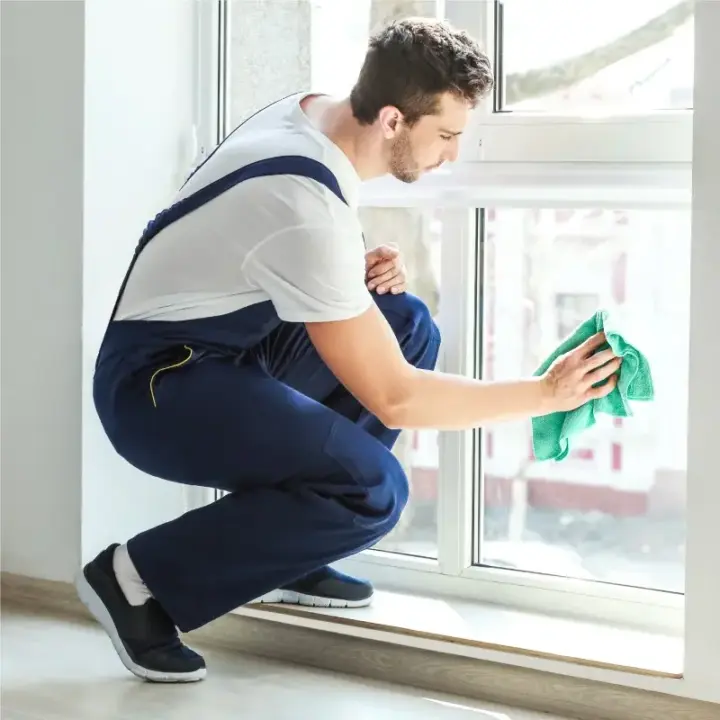
Choose a window cleaner whose quote names the access method, includes frames, sills and tracks, and matches the frequency to your building's exposure. They should be clear about what they cannot do, such as rope access on a high-rise, and show you their certificate of currency rather than just saying they are insured.
Does the quote name the access method? If it does not, nobody has planned the work at height and you are the occupier.
Are frames, sills and tracks included? A clean pane over a gritty track looks worse than before.
Will they say what they cannot do? A commercial cleaner quoting rope access on a high-rise is quoting outside their discipline.
Is the frequency matched to your exposure? A coastal or main-road building needs a shorter cycle, and a provider who has not mentioned it has not looked at your site.
Is there insurance evidence you can actually see? Ask for the certificate of currency, not a statement.
Then the basics: ABN, current public liability insurance, and a written quote stating access method, scope and frequency.
Offices schedule internal glass inside their office cleaning contract, strata schemes include lobby glazing in their common property scope, and many sites add carpet cleaning to the same out-of-hours visit.
See the full range of commercial cleaning services across Sydney.
It starts with a look at your building, including the ground beneath the glass, because that decides which access methods are possible. We then send a written quote naming elevations, access method, frames and tracks and a recommended frequency, book a time that suits the building, and set up a regular cycle.
A look at the building, including the ground beneath the glass, because that is what decides which access methods are even available.
A written quote. Elevations covered, access method named, frames and tracks stated as in or out, frequency recommended against your exposure, and anything we will not attempt identified plainly.
A booking that suits the building. Before opening for retail, outside business hours for offices, and never in the middle of a hot afternoon on a west-facing elevation.
A cycle rather than a one-off, so the glass stays right instead of being rescued twice a year.
You approve the price before anything starts.
What building and office managers ask before booking glass work.
No. Rope access and building maintenance unit work on high-rise facades is a specialist discipline with its own training, equipment and regulatory requirements, and a general commercial cleaner should not be quoting it. We clean internal glazing and external glass reachable safely from the ground or a platform, and we will tell you plainly where that line falls on your building.
Say which you want and it goes in the quote explicitly. It changes the time materially, and a clean pane above a gritty track looks worse than not cleaning at all.
Purified water through a pole system dries without spotting and needs no squeegee finish. The usual causes of streaking are dirty water, working in direct sun so the glass dries before it is finished, or cleaning just before rain — which is why hot-weather work is scheduled early or onto a shaded elevation.
Yes, and it is usually cheaper and more consistent that way — a stated frequency and price as a line item, rather than ad hoc bookings that slip.
Water-fed pole systems reach several storeys from the ground, which keeps everyone off ladders. They need clear ground access beneath the glass, so awnings, planting, parked cars or an overhanging building line can rule them out. Where they cannot be used, the alternative is an elevated work platform, quoted separately.
Exposure decides it. Street-front retail needs the entry and shopfront weekly at minimum; office entries weekly to fortnightly; internal partition glass monthly to quarterly; general external glass quarterly to half-yearly. Coastal salt and main-road traffic film both shorten those intervals noticeably.
Sometimes. That is restoration rather than cleaning and it is quoted separately after inspection. Long-standing mineral etching may not come out fully, and we will say so before the job rather than after it.
We carry public liability insurance and can provide our certificate of currency before work starts. Ask for it rather than accepting a statement.
Most shopfronts need the entry door and lower glass cleaned weekly, and the full frontage inside and out…
Explore How Often Should Shopfront Windows Be Cleaned?
What Are Some Of The Best Window Cleaning Solutions? Cleaning your windows requires a lot of technical expertise,…
Explore Best Window Cleaning Solutions That Make Simple
Window Cleaning Tools, Supplies And Equipment! Cleaning itself is getting harder by the day. Windows are just one…
Explore Best Window Cleaning Tools And Supplies
Are You Looking For Commercial Window Cleaning Tips? Have you ever wondered why that only professional are able…
Explore Handy Commercial Window Cleaning Tips
The Common Causes of Dust on Commercial Windows You Didn’t Know Commercial windows collect dust much faster than…
Explore Common Causes of Dust on Commercial Windows
Effective Window Track Cleaning Services Here’s a scenario that you might relate to. You are having a particularly…
Explore Best Window Track Cleaning Services In Sydney
Premium High Rise Window Cleaning Services In Sydney! High-rise window cleaning is a specialized field of work that…
Explore Best High Rise Window Cleaning Services In Sydney
A Comprehensive Guide to Cleaning Aluminium Window Frames Aluminium window frames are fairly popular and for good reasons!…
Explore How To Clean Aluminium Window Frames?
Think Commercial Window Cleaning In Sydney Is Easy? Well, not really. There’s a far deeper complexity that lies…
Explore Challenges Faced By Commercial Window Cleaners
We have a range of commercial cleaning services that can cover any cleaning requirement of yours. Check our offerings here!
Make way to a productive workspace that is lean, safe, and completely hygienic with JBN Cleaning.
Commercial CleaningBoost your employee productivity multiple times by cleaning every corner there is to perfection.
Office CleaningCareful, thorough cleaning for all your sensitive requirements. We’ve got your back!
Childcare CleaningDon’t sweat out on cleaning. Our experts can seamlessly do that for you and give your gym a vibe of motivation.
Gym/Fitness Cleaning