
Most factories need both: light, safe tasks such as walkways, amenities and spills during production, and the heavy work, such as floor scrubbing, degreasing and high dusting, between shifts, after hours or in a planned shutdown. After-hours is where that heavy work belongs, because the machines are off, nobody is disrupted, and there is no risk of contaminating product. The exception is anything urgent or safety-related, such as a spill, which is cleaned the moment it happens. The right split comes down to safety, contamination risk and whether the plant runs around the clock. This guide works through each, so you can set a routine that fits how your site actually runs.
When Is After-Hours Cleaning Better?
For most of the work, after hours wins easily. With the line stopped there are no moving machines or forklifts to work around, so the crew can safely scrub floors, degrease equipment surrounds, clear high-level dust and reach the areas a running plant blocks off. Nothing interrupts output, and in food or pharmaceutical sites there is no exposed product to contaminate. This is why after-hours factory cleaning is the standard for the deep, detailed jobs, and why most manufacturers schedule their main clean for the gap between shifts. It is also easier to leave a clear record of a full after-hours clean, which matters when an auditor or a client asks for proof the work was done.
When Should You Clean During Production?
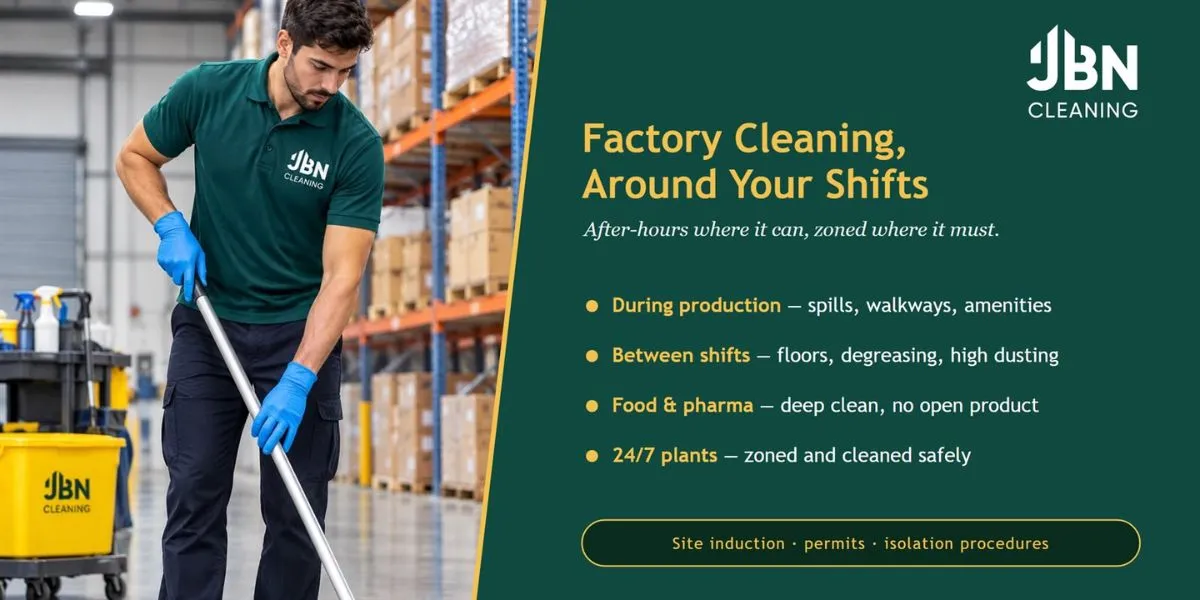
Some cleaning cannot wait for the shift to end. Spills, broken glass and anything that creates a slip or safety hazard are cleaned straight away, whenever they happen. Food plants also need immediate attention to spills and set tasks between production runs to stay compliant, as covered in our guide to food factory cleaning. On top of that, light housekeeping keeps walkways, amenities and bins under control through the day. Cleaners clean the floor and the outside of machinery, never working parts or anything that needs isolating; that stays with your maintenance team under your lock-out and tag-out procedure. The rule for factory cleaning during production is simple: keep it light, keep it safe, and leave the heavy work for later.
What Decides the Split?
The balance between the two is set by a few clear factors. The table below shows how each one usually falls.
| Factor | During production | After hours |
|---|---|---|
| Heavy deep clean (floors, degreasing, high dusting) | No, unsafe and disruptive | Yes, the right time |
| Spills and safety hazards | Yes, clean immediately | Handled as part of the round |
| Food or pharma areas with open product | No cleaning near exposed product | Deep clean and sanitise |
| Housekeeping, walkways and amenities | Yes, light upkeep | Yes |
| A plant running 24/7 with no downtime | Zone and clean around the line | Not available, so zoning is essential |
Put simply, the dirtier, heavier or riskier the job, the more it belongs after hours, while quick, safe and urgent tasks are done as they come up.
What About Factories That Never Stop?
A plant that runs 24/7 has no after-hours window, so the work is zoned instead. The cleaning crew moves through the site area by area, cleaning sections that are stopped and made safe by your maintenance team while the rest keeps running, and coordinates closely with shift supervisors. It takes more planning, but it keeps a continuous operation clean and compliant without ever stopping the line. This is a core part of good industrial cleaning for round-the-clock sites, where the food plants in particular often write their in-shift cleans into a food safety program so they are done to a set method every time.
Why Does the Timing Decision Matter?
Getting the split right is a safety, output and compliance decision, not just a scheduling one. Clean at the wrong time and you risk an incident around live machinery, a contamination problem in a food area, or a line stopped for no good reason. Clean at the right time and the plant stays safe, keeps running and stays audit-ready, while the deep work still gets done properly. It is how a good factory cleaner plans the work, from a single workshop to a large manufacturing plant.
Frequently Asked Questions
Is it better to clean a factory during or after production?
After production for the heavy work, because the machines are off, nobody is disrupted and there is no contamination risk. Only light, urgent or safety tasks, such as spills, are done during production.
Can a factory floor be scrubbed while the line is running?
Generally no. Floor scrubbing near moving machinery and forklifts is a safety risk, so it is scheduled after hours, between shifts or in a planned shutdown.
How are factories that run 24/7 cleaned?
By zoning, the crew cleans sections that are stopped and made safe by your maintenance team while the rest of the plant keeps running, coordinating with supervisors so the line never has to stop.
Who should do factory cleaning?
A provider experienced in industrial sites, who works to WHS requirements, understands contamination risks and can schedule around your shifts rather than forcing you to work around them.
Who isolates machinery before cleaning?
Your maintenance team, under your site’s lock-out and tag-out procedure. Cleaners work to your site induction and permits, and do not clean working parts or inside guards.
Industrial and Factory Cleaning in Sydney
The best results come from a provider that plans the clean around how your site actually runs, after hours where it can, zoned where it must. JBN Cleaning cleans factories and manufacturing plants across Sydney, with trained crews working to your site induction, permits and isolation procedures, and schedules built around your shifts. Whether you need cleaning between shifts, after hours or in a planned shutdown, it is handled to one standard. See our industrial cleaning page, or call 1300 908 678 or 02 9188 5449, or email info@jbncleaning.com.au for a free, no-obligation quote.
