
What Ventilation Cleaning Actually Does for Allergy Levels in Commercial Buildings
People in offices, schools, medical centres, and aged care facilities tend to assume that the air they breathe inside is cleaner than the air outside. In Australia, that is often the opposite of the truth. Indoor air in buildings with old, neglected, or under-serviced HVAC systems can carry significantly higher concentrations of dust, pollen, mould spores, and pet dander than the street outside.
The system that is supposed to filter and circulate clean air becomes the thing distributing the irritants.
For staff and visitors with allergies or respiratory sensitivity, this matters every working day. Dry coughs, congestion, headaches, watery eyes, and afternoon fatigue are all symptoms that follow people from suburb to suburb but get blamed on hayfever, screen time, or tiredness. Often, the building’s air handling is the actual source.
How does ventilation cleaning help reduce allergies? By removing the accumulated allergen reservoir before it gets blown across every floor of the building — and that change shows up in symptoms within weeks, not months.
How Allergens Reach People Through the Air System
Modern commercial HVAC moves enormous volumes of air. A typical office system cycles the building’s air several times per hour. Each cycle pushes air through the duct network and out through ceiling registers into occupied spaces.
If the duct walls are coated in dust and the supply registers have visible build-up, every air cycle dislodges some of that material into the breathing space below. Sensitive occupants are then exposed to those particles continuously through the working day.
The dose builds up quietly — people walking into the building feel symptoms within minutes, but staff present all week often dismiss it as a cold or general fatigue. The connection between “the office” and “feeling unwell” takes time to spot.
How Ventilation Cleaning Cuts Allergy Triggers
Properly executed commercial ventilation cleaning addresses the allergen problem at its source rather than at the receiving end. Three changes happen:
The reservoir is removed. Years of accumulated dust, pollen, dander, and mould spores are physically extracted from the duct walls, registers, fans, and coils. Once gone, they cannot circulate any more.
The system runs cleaner going forward. Clean ducts and clear coils mean the filter does its job for longer because it is not playing catch-up against a backlog. New particulate is captured at the filter rather than being added to layers already deposited deeper in the system.
Mould risk drops. Coil cleaning and condensate-pan servicing removes the wet, organic-rich environment where mould grows. That eliminates a particularly aggressive allergen and respiratory irritant that conventional cleaning never touches.
Studies of indoor air quality consistently show measurable reductions in airborne particulate after a thorough ventilation clean — and staff with allergies report symptom relief within the first month, often sooner.
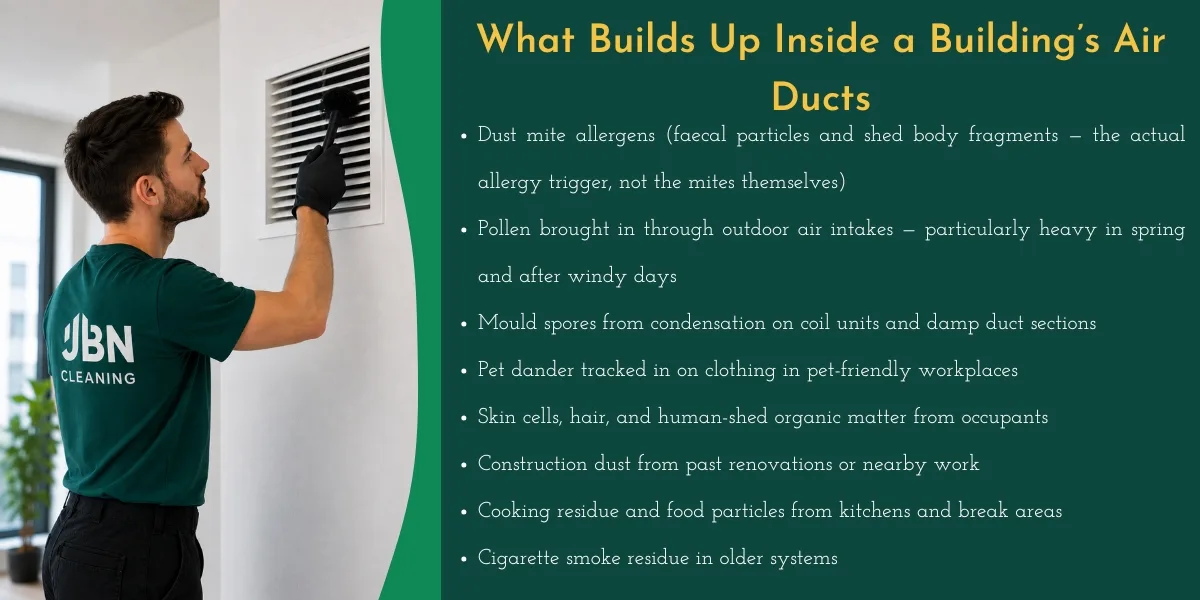
What Builds Up Inside a Building’s Air Ducts
The inside of a typical commercial duct system is not a clean space. Over months and years, an HVAC network collects:
- Dust mite allergens (faecal particles and shed body fragments — the actual allergy trigger, not the mites themselves)
- Pollen brought in through outdoor air intakes — particularly heavy in spring and after windy days • Mould spores from condensation on coil units and damp duct sections
- Pet dander tracked in on clothing in pet-friendly workplaces
- Skin cells, hair, and human-shed organic matter from occupants
- Construction dust from past renovations or nearby work
- Cooking residue and food particles from kitchens and break areas
- Cigarette smoke residue in older systems Filters catch a portion of this, but they do not stop it.
Filters need replacing on schedule, and the duct walls, fan blades, coil units, and supply registers downstream of the filters all collect debris that gets disturbed every time the system cycles on.
Frequently Asked Questions
How quickly do staff allergy symptoms improve after a duct clean?
Most occupants notice a difference within 1–4 weeks. The system needs a few cycles to confirm that what was removed stays removed and that filters are doing their job under normal load. Severe sensitivity cases sometimes report relief within days.
Will ventilation cleaning fix mould problems?
It removes existing mould inside the system and the conditions where it grows (dust, organic matter on damp coils). If the building has structural moisture problems — a leaking roof, plumbing issues, condensation in walls — those need to be fixed separately. Cleaning addresses the symptom; the underlying water source has to be solved by the right trade.
Does ventilation cleaning improve energy efficiency?
Yes, often noticeably. Clean coils transfer heat more efficiently, clean fans move air with less power draw, and clean ducts have less restriction. Most buildings see a measurable drop in HVAC energy use after a thorough clean — the saving partly offsets the cost of the work.
Can the building stay open during ventilation cleaning?
Most jobs are run after-hours or on weekends so the building is empty during the work. Where that is not possible, containment systems isolate the cleaning zone from occupied spaces. Sensitive areas like medical clinics or childcare rooms are usually scheduled outside operating hours regardless.
Final Thoughts
The reason how ventilation cleaning helps reduce allergies is a worthwhile question is that the answer is unusually concrete. Allergens build up in ducts because that is where they accumulate; they reach occupants because the system that is supposed to filter them is the same system that distributes them; cleaning removes the reservoir at its source.
They build ventilation cleaning into a multi-year maintenance schedule alongside the regular cleaning rounds provided by a trusted commercial cleaning company such as JBN Cleaning — and the difference shows up not just in fewer sick days, but in a workplace that genuinely feels better to be in.
